
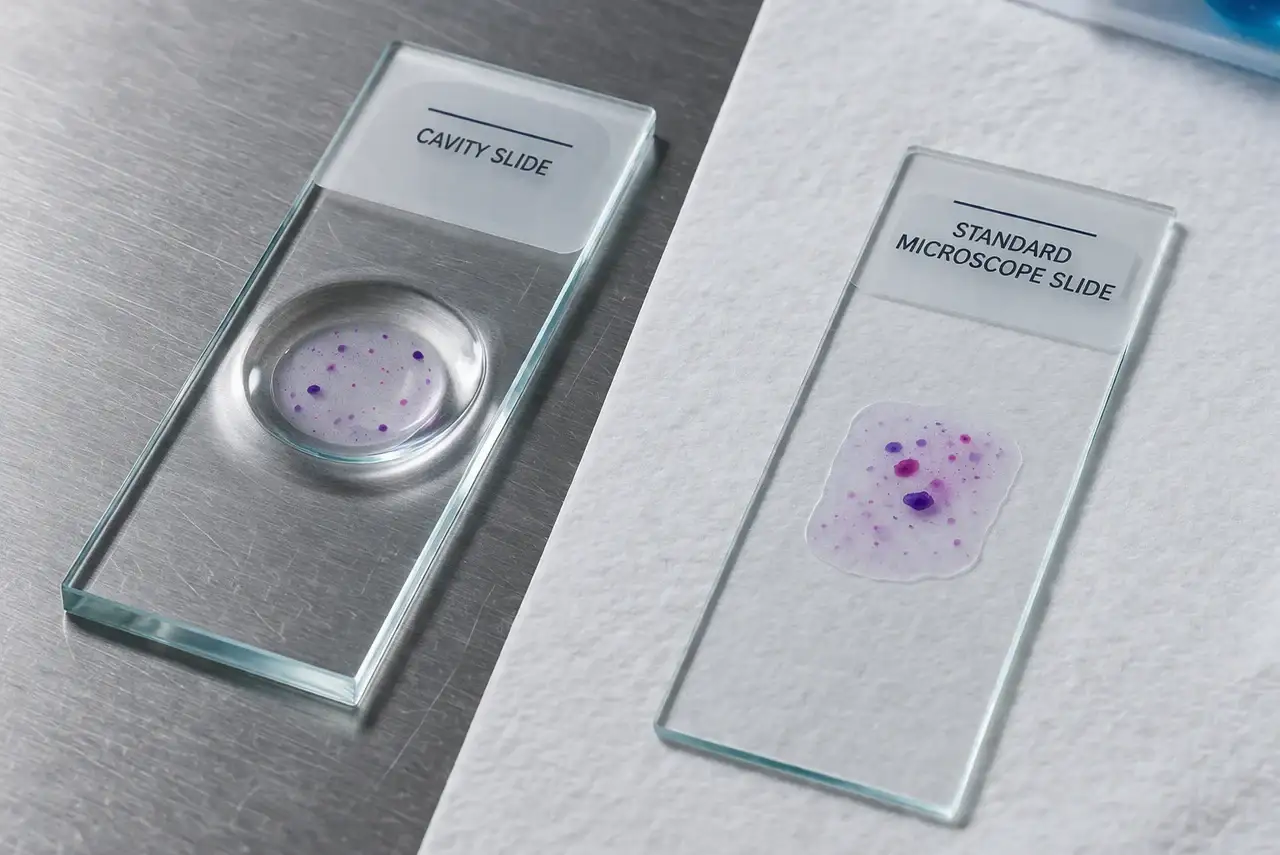
Misjudging slide requirements can lead to unreliable findings, but choosing between cavity slides and standard microscope slides can yield better outcomes.
Your results can go wrong before you even start observing, and the slide you choose is often the reason.
In microscopy, sample preparation is not just about placing material under a lens. The type of slide used can affect how clearly the specimen appears, how it behaves, and how accurately it can be analysed.
Cavity slides microscope setups are suitable for liquid or live specimens that need space and depth to maintain their natural state. Standard microscope slides are flat and work best for thin, fixed samples that require even and stable placement.
Being aware of these slide types and using equipment from Blue Star Slides ensures accurate handling, clear observations, and dependable results in any lab setting.
What Are Standard Microscope Slides?
Standard microscope slides are flat glass pieces used to hold samples for observation under a microscope. They provide a smooth, stable surface that helps prepare thin, clear specimens for accurate analysis.
Key Features
- Flat and smooth glass surface
- Used with a coverslip for protection
- Supports thin and evenly spread samples
- Provides stable placement during observation
Best Used For
- Blood smears
- Tissue sections
- Stained samples
- Permanent mounts
Why They Are Widely Used
- Simple and easy to handle
- Suitable for routine lab work
- Works well for high clarity imaging
- Common across diagnostic and research labs
Standard microscope slides are widely preferred because they offer consistency, ease of use, and reliable results for thin and fixed samples across different lab environments. Their simple design also makes them a practical choice for maintaining uniformity in everyday laboratory procedures.
What Is a Cavity Glass Slide?
A cavity glass slide is a specialised slide designed with one or more concave depressions that can hold liquid or thicker samples. This design allows the specimen to stay in its natural form without being flattened during observation.
These slides create a small well in the surface, providing space for samples that require depth or movement. They are available in different formats based on the number of depressions.
Types of Cavity Slides
- Single cavity design for basic observations
- Double cavity design for comparative or multiple samples
A single cavity slide is ideal when one sample needs to be observed clearly without interference.
On the other hand, a double cavity slide provides space for two samples, allowing side-by-side comparison or simultaneous observation under the microscope.
Where They Are Used
- Live cell observation
- Hanging drop technique
- Liquid cultures
- 3D or thick specimens
Why They Are Useful
- Do not require a coverslip in most cases
- Maintain natural sample structure
- Allow movement in live specimens
- Reduce sample damage during observation
Glass slide with cavity is useful when sample depth and movement are important, providing a reliable way to observe liquid and live specimens in laboratory settings. Their concave design ensures samples remain intact and visible, allowing accurate observation without distortion.
Side-by-Side Comparison
Choosing the right slide type can be confusing, but understanding the differences between them helps ensure accurate results. Standard microscope slides and cavity slides serve distinct purposes in the lab, and comparing their features side by side makes it easier to select the appropriate one for your samples.
| Feature | Standard Microscope Slides | Cavity Slides |
| Specimen Type | Flat, fixed samples | Liquid, thick, or 3D samples |
| Coverslip Required | Yes | Optional |
| Sample Depth | Thin | Accommodates volume and depth |
| Use Case | Histology, cytology, stained samples | Microbiology, embryology, live specimens |
| Reusability | Can be cleaned and reused | Can be cleaned; more durable for repeated use |
Both slide types have specific strengths depending on the application. Standard slides are ideal for thin, fixed specimens, while cavity slides offer greater flexibility for liquid and dynamic samples. Knowing these differences helps laboratories maintain clarity, accuracy, and consistency in observations.
When Should You Use a Cavity Slide?
Cavity slides are ideal for situations where samples need space and depth for accurate observation. They are designed to handle specimens that cannot be flattened without affecting results, making them essential in certain lab applications.
Practical Uses of Cavity Slides
- Hanging drop technique to observe motility
- Culturing microorganisms, yeast, or other liquid samples
- Observing live organisms such as protozoa and algae
- Embryo or sperm motility analysis in fertility labs
- Pediatric or clinical microbiology studies
For labs that uses cavity slides microscope, delicate samples remain intact while being observed, allowing accurate results. This setup is especially valuable when maintaining the sample’s natural movement or structure is critical for accurate analysis.
Does Slide Quality Affect Your Results?
The quality of a microscope slide plays a crucial role in achieving accurate and reliable observations. Even minor imperfections in glass clarity, cavity depth, or edge finishing can affect focus, distort the sample, or introduce contamination. Using well-made slides ensures that laboratory results are consistent and reproducible.
Key Factors in Slide Quality
- Glass Clarity
- High transparency allows clear visualization of the specimen
- Reduces light scattering and improves contrast
- Cavity Depth Consistency
- Ensures uniform sample thickness
- Prevents uneven focus or compression of specimens
- Edge Finishing
- Smooth edges prevent cuts or damage during handling
- Minimizes risk of sample leakage or breakage
- Manufacturing Standards
- Reliable slides adhere to ISO and ASTM standards
- Consistent quality supports accurate lab analysis
Choosing products from trusted microscope slide manufacturers in India ensures compliance with quality standards and minimizes the risk of errors caused by poorly produced glass. High-quality slides not only improve observation but also protect sensitive samples, making them a critical choice for any laboratory setting.
Guide to Using the Correct Slide in Your Laboratory
Using the correct type of slide is essential for accurate results and efficient lab work. Different samples and applications require specific slide designs, so making the right decision saves time and ensures reliable observations.
- Opt for standard microscope slides for thin, fixed, or stained specimens
- Go for cavity or single cavity slides for live, motile, or suspended samples
- Consider cavity depth (e.g., 0.5 mm vs. 1 mm) based on sample volume
- Always source slides from certified manufacturers to ensure consistent quality
Following these guidelines helps laboratories improve accuracy, protect delicate specimens, and maintain consistency across experiments. The right slide ensures every observation is clear, precise, and reproducible.
Ensure Accurate Results with the Right Slides
Understanding the differences between standard microscope slides and cavity slides is key to preparing samples effectively. Each type is designed for specific specimen needs: flat slides are ideal for thin, fixed samples, while cavity slides provide space for liquids, live cells, or thicker specimens.
Blue Star Slides offers precision-engineered slides that support a wide range of laboratory applications. Their products combine clarity, consistent quality, and durability, allowing labs to rely on them for accurate observations and smooth workflow.
Using the appropriate slide ensures that samples remain intact and results are dependable. With the right slide in hand, laboratories can minimise errors, maintain sample integrity, and achieve clear, reproducible observations every time. Get started with them and ensure precise results for all your laboratory samples.