
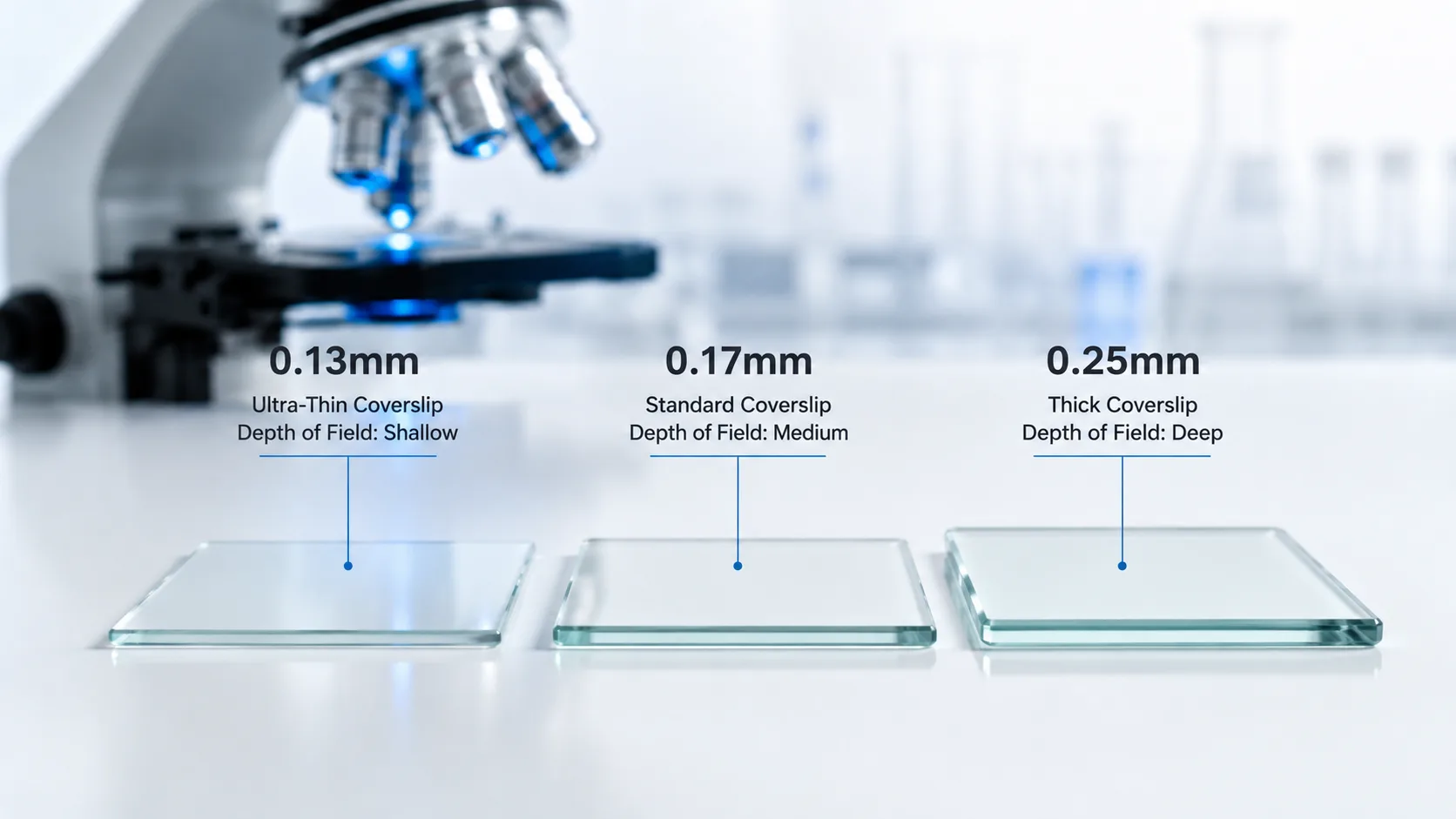
Even when a specimen is prepared correctly, using the wrong coverslip thickness can affect image quality under the microscope. Blurred images, reduced sharpness, and focusing issues are often linked to improper coverslip selection.
Many laboratories focus on slide preparation and microscope settings but overlook the importance of choosing the right coverslips for microscope slides. The thickness of a coverslip plays an important role in how light passes through the sample and how clearly details can be viewed.
Most microscope objective lenses are designed to work with a specific coverslip thickness. Using the correct laboratory coverslip improves image clarity, supports accurate observation, and ensures better microscope performance in both routine and advanced applications.
Understanding coverslip thickness helps labs choose the right option for various microscopy techniques and tests.
Why Coverslip Thickness Matters
Choosing the correct coverslip thickness helps maintain clear and accurate microscope imaging. Most microscope lenses are designed to work with a specific thickness, and even a small variation can affect the final result.
Here’s why thickness matters in microscopy:
- Objective lenses are pre-corrected for a standard thickness
Most microscope objectives are designed for a 0.17 mm thick microscope slide cover glass, also known as No. 1.5.
- Wrong thickness can reduce image clarity
If the coverslip is too thick or too thin, light may not focus properly through the sample.
- Image distortion can occur
Using the wrong microscope cover glass can cause optical issues, such as blurry edges or reduced sharpness.
- High magnification is more sensitive
In advanced microscopy applications, even a slight difference in thickness can affect image quality and accuracy.
- Better compatibility improves microscope performance
Choosing the correct coverslip helps achieve smoother focusing and more reliable observations during laboratory analysis.
Standard Coverslip Thickness Designations
Different coverslip thickness grades are available for different microscopy applications. Choosing the right thickness helps improve image clarity and microscope compatibility.
| Coverslip Grade | Thickness Range | Common Usage |
No. 0 | 0.08–0.12 mm | Ultra-thin coverslips used for special applications where minimal thickness is required. These are not commonly used in routine laboratories. |
No. 1 | 0.13–0.17 mm | Suitable for general laboratory work, educational use, and routine microscopy procedures. |
No. 1.5 | 0.16–0.19 mm | The most commonly recommended microscope cover slip thickness. Works well with many modern microscope objectives and high-resolution imaging systems. |
No. 2 | 0.19–0.23 mm | Thicker coverslips used for specific laboratory applications where additional strength or spacing is needed. |
Many laboratories prefer microscope glass coverslips in No. 1.5 thickness because they provide better compatibility with advanced microscope systems and imaging techniques.
Matching Thickness to Your Objective Lens
The correct coverslip thickness should always match the microscope objective lens being used. Most objective lenses have the recommended thickness marked directly on the lens barrel.
Here are a few important points laboratories should check:
- Look for the “0.17” marking on the objective lens
This marking indicates the lens is designed for coverslips 0.17 mm thick, typically No. 1.5.
- High-performance objectives are more sensitive
Plan and Apo objective lenses require more precise thickness matching for clear, detailed imaging.
- Lower magnification lenses are more flexible
Objectives such as 10× or 20× can usually tolerate small thickness differences without major image issues.
- Advanced imaging needs precise matching
When it comes to fluorescence microscopy, confocal microscopy, or oil-immersion microscopy, it is extremely important to use the appropriate coverslips on microscope slides.
It is always advisable to know your lenses’ specifications before deciding which coverslips to use, to ensure you get the most out of your microscope.
Application-Specific Recommendations
Different microscopy applications may require different coverslip thicknesses for optimal viewing. Selecting the right option helps improve image quality and microscope accuracy.
- Fluorescence Microscopy
Fluorescence and confocal microscopy usually work best with No. 1.5 coverslips. These applications require precise light transmission, which is why many laboratories use a high-quality laboratory coverslip with a standard thickness of 0.17 mm.
- Brightfield and Routine Histology
Both Nos. 1 and 1.5 coverslips are widely used in laboratories and in histology. A normal microscope slide cover glass is sufficient for ordinary use.
- Live Cell Imaging
Live-cell imaging demands an extremely precise coverslip thickness. Most laboratories use No. 1.5H coverslips as they provide better thickness tolerance.
- Oil Immersion Microscopy
Oil immersion requires more precise optics. The use of No. 1.5 coverslips ensures clear images at high magnifications.
Other Factors to Consider
In addition to thickness, there are several other factors that laboratories should consider when selecting coverslips.
- Coverslip Size
Different applications require different coverslip dimensions. Common sizes include:
- 18 × 18 mm
- 22 × 22 mm
- 24 × 60 mm
The right size depends on the sample area and slide coverage requirements.
- Glass Quality
The quality of the microscope cover glass also affects microscope performance. Borosilicate glass is commonly preferred because it offers better optical uniformity and chemical resistance than standard soda-lime glass.
- Edge Finish
Sharpened edges ensure safe handling and minimise risks of injury while preparing slides. Proper edge sharpening is helpful in routine laboratory work and when mounting coverslips.
Common Mistakes to Avoid
Even when using the right microscope and sample preparation, a few common coverslip mistakes can still harm image quality and lab results.
- Using Thick Coverslips With High-Resolution Objectives
High NA and high-performance objectives are generally made for No. 1.5 thickness. The use of thick coverslips, such as No. 2 thickness, without appropriate adjustment settings may decrease the resolution of the images obtained.
- Mixing Different Coverslip Brands Without Checking Tolerance
Coverslips do not necessarily have the same thickness range. Certain brands may differ from one another, and it is important to verify these differences before using the microscope for imaging.
- Ignoring the Mounting Medium
The refractive index of the mounting medium also influences image resolution. Even when the proper microscope cover slip is used, an inappropriate mounting medium will affect light transmission and degrade the viewing results.
- Choosing Coverslips Only Based on Cost
Products of lower cost do not necessarily offer consistent thickness and optical properties. It is common practice in laboratories to choose higher-quality microscope glass coverslips.
Selecting the Right Coverslip for Better Microscopy Results
Selecting the correct cover glass thickness ensures proper imaging in microscopes. Though the requirements may vary by purpose, No. 1.5 is the preferred choice due to its compliance with most specifications for microscope lenses available today.
Using the correct type of laboratory coverslip will help ensure that images produced under the microscope are clear and accurate. Ensuring that one understands the objective lens specification before selecting a coverslip will help laboratories avoid such problems.
Blue Star Slides manufactures high-quality microscope cover glass. The cover glasses have been made using precision techniques to ensure that they meet the exacting standards required in laboratories. They are ideal for use by pathology labs, research institutions, hospitals, and scientific distributors.