
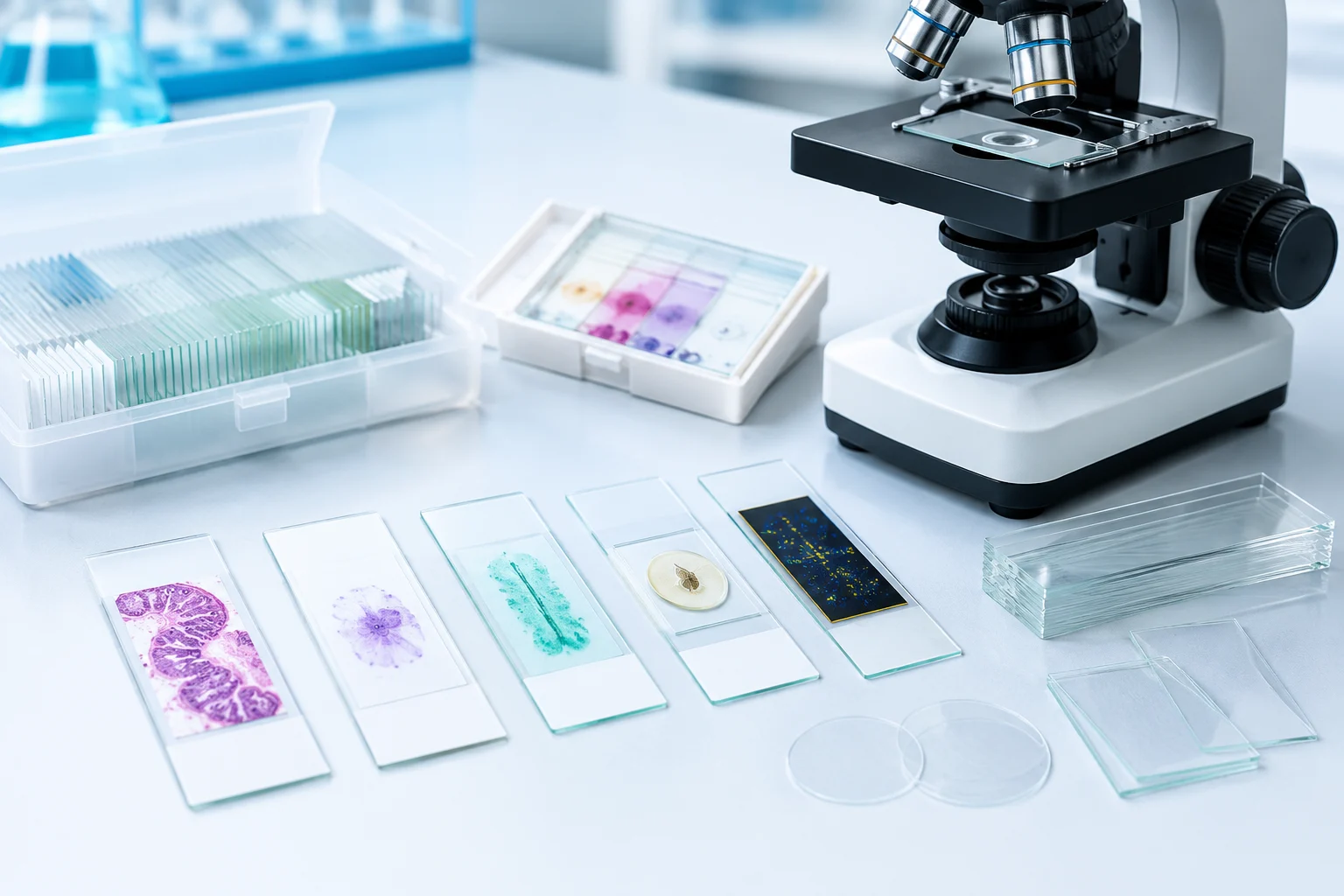
Microscope slides may look alike, but they are not all designed for the same job. Different slide designs suit different specimen types, preparation methods and laboratory applications. Choosing between plain, frosted, cavity, prepared and specialised microscope glass slides affects how easily a sample can be labelled, held in place and viewed. This guide explains the main types of microscopic slides, what makes each one different, and how to match the right one to your work.
What Are Microscope Slides?
A microscope slide is a thin, flat rectangle of glass that holds a specimen for microscopic examination. The standard format measures about 75 mm by 25 mm, and the smooth, transparent glass lets light pass through the sample to the objective lens. The specimen is usually covered with a thin coverslip to keep it flat and protected. Slides used in clinical, research and teaching settings are commonly grouped as laboratory slides, and the term glass slides covers the whole family. Quality matters: clear glass, smooth edges and a flat surface all help produce sharp, distortion-free images.
Common Types of Microscope Slides
Plain Microscope Slides
Plain microscope slides are blank glass with no markings or specimen. Often called plain micro slides, they are used to prepare and mount specimens by hand, and they remain the most widely used microscope glass slides for general work.
Frosted Microscope Slides
Frosted microscope slides have a matte, roughened area at one end. This frosted section takes pencil or marker ink well, making it easy to write patient details, sample numbers or dates. Frosted slides are valuable wherever specimens must be identified and tracked, and frosted glass slides help prevent mix-ups in busy laboratories.
Cavity Slides
Cavity slides have a shallow, concave well ground into the glass. Cavity microscope slides hold thicker specimens or liquid samples, such as pond water, cultures or hanging drops, without crushing them. A cavity glass slide is a good choice when a flat surface would not hold the sample.
Prepared Slides
Prepared slides come with the specimen already mounted and ready for examination. Prepared slides for biology and other biology slides for microscope use are widely used in education, where learners need reliable reference specimens.
VDRL Slides
VDRL slides are specialised slides with ringed or recessed wells, used in serological testing where a serum sample is mixed with a reagent and observed for a reaction. VDRL glass slides serve a clinical diagnostic purpose rather than general viewing.
Adhesive / Charged Slides
Adhesive or charged microscope slides have a treated surface that helps tissue sections stay attached during staining and washing. They are common in histology and other laboratory slides workflows where specimen loss would ruin the result.
How to Choose the Right Microscope Slide
Start with what you need the slide to do. Consider:
- Specimen type: dry, wet, thin or thick.
- Preparation method: manual mounting, staining or ready-made.
- Need for labelling: choose frosted slides for easy identification.
- Adhesion requirements: choose charged slides for tissue sections.
- Liquid or thick specimens: choose cavity slides.
- Intended laboratory application: from teaching to diagnostics.
Matching these factors to the right microscope slides saves time, reduces wasted samples and gives cleaner, more reliable results.
Microscope Slides for Different Laboratory Applications
In biology education, prepared slides and plain slides let students both observe reference specimens and practise their own mounting. In histology, charged slides hold thin tissue sections through staining. In pathology, frosted slides help label patient samples, and pathology slides are central to examining tissue and cells for signs of disease. General laboratory work relies on plain, frosted and VDRL slides for routine screening and testing, while microscopy research uses high-quality glass for precise, repeatable observation. Knowing which slide suits which task keeps workflows efficient and results consistent.
Microscope Slides and Coverslips: How They Work Together
A slide holds the specimen from below, while a coverslip is a much thinner piece of glass placed on top. Using microscope slides and coverslips together flattens the sample, keeps mounting medium in place and protects the objective lens. Many labs also refer to microscope slides and cover slips as a pair, and coverslips for microscope slides should match the slide size and the thickness your objective requires. A good microscope slide cover glass is thin, clear and free of scratches, so it does not interfere with focus or image quality.
The main types of microscope slides are plain, frosted, cavity, prepared, VDRL and charged, and each serves a distinct purpose. The best choice depends on the specimen, your preparation technique and the laboratory application. Selecting the right microscope glass slides and laboratory slides improves clarity, saves time and supports reliable results.